Tell us about the job
Takes about a minute. No obligation.
A water heater replacement in this area starts with questions a catalog spec sheet cannot answer alone. 87 severe weather events were recorded in Dearborn County, Indiana between 2015 and 2024. At that rate, severe weather is a genuine part of the operating environment, but it sits in the middle range of what systems here contend with over time. A contractor quoting a new unit has to account for that load without letting it overshadow the factors that drive most failures: the age of the existing unit, how it was originally installed, and whether the venting and connections have held up. Those details shape the sizing decision as much as anything the local climate contributes.
Electrical panels in older housing were sized for what people plugged in at the time, and an electric water heater draws more than most of those panels were wired to handle cleanly. Half the homes in Dearborn County, Indiana were built in 1982 or earlier (2020-2024 ACS 5-year). A contractor quoting a water heater swap in stock like this checks the service panel before pricing the unit, because undersized circuits turn a straightforward replacement into a panel upgrade. That is not a rare edge case in Dearborn County. It is a routine finding.
What Gets Installed With a New Water Heater
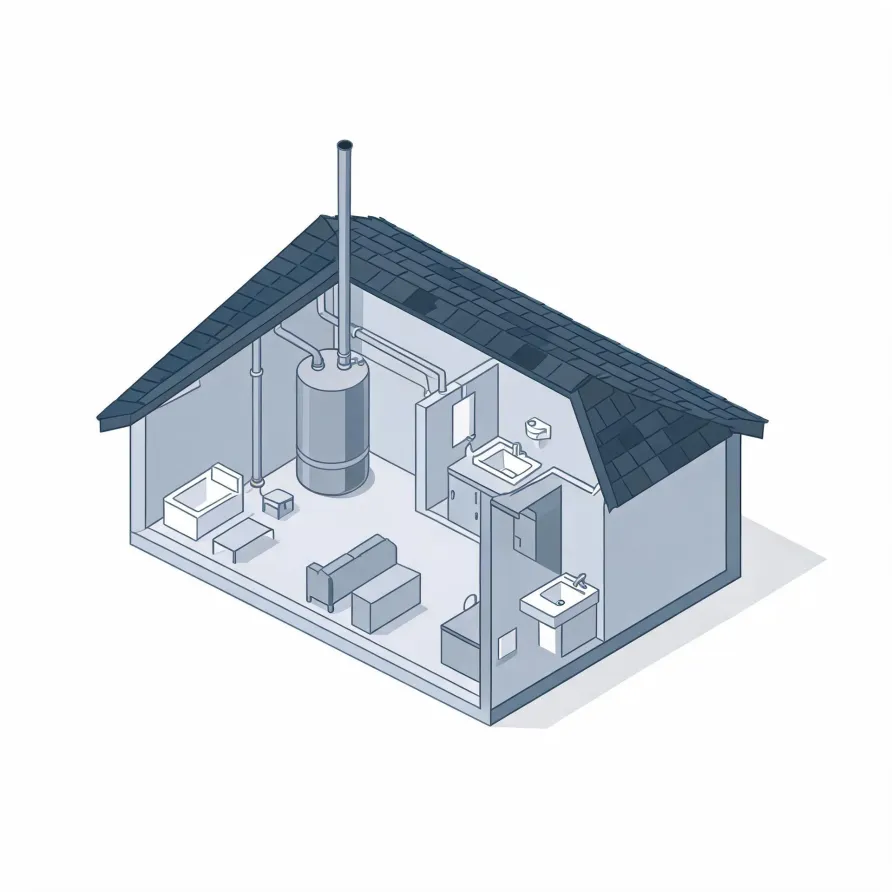
The tank is the centerpiece of the system. It sits in a utility room, basement, or garage and holds a supply of water that a burner or heating element keeps at temperature. The pressure relief valve mounts directly on the tank and releases pressure if it climbs too high.
The cold water inlet line feeds into the top of the tank, and the hot water outlet carries heated water out to the rest of the house. A drain valve sits near the base of the tank. The flue or exhaust vent runs from the top of a gas unit up through the wall or roof to carry combustion gases out.
The drawing shows a typical layout, and a licensed contractor determines what the installation requires in your specific home.
Get matched in Dearborn CountyDearborn County, Indiana, by the numbers
87 severe weather events were recorded in Dearborn County, Indiana between 2015 and 2024.
NOAA National Centers for Environmental Information, Storm Events Database, bulk CSV export, events 2015-01-01 through 2024-12-31.Half the homes in Dearborn County, Indiana were built in 1982 or earlier (2020-2024 ACS 5-year).
U.S. Census Bureau, 2020-2024 American Community Survey 5-Year EstimatesDearborn County, Indiana holds 21,098 housing units (2020-2024 ACS 5-year).
U.S. Census Bureau, 2020-2024 American Community Survey 5-Year EstimatesOwners occupy 85.2% of the occupied homes in Dearborn County, Indiana (2020-2024 ACS 5-year).
U.S. Census Bureau, 2020-2024 American Community Survey 5-Year EstimatesSevere Weather Events in Dearborn County
Weather puts real load on water heating equipment, and that load varies by where you live. What rolls through Dearborn County shapes how hard the system works and what it needs to hold up over time.
87 severe weather events, 2015–2024. Source: NOAA National Centers for Environmental Information, Storm Events Database.