Tell us about the job
Takes about a minute. No obligation.
A furnace installation in Dearborn County is a local calculation, not a catalog pick. 87 severe weather events were recorded in Dearborn County, Indiana between 2015 and 2024. At that rate, severe weather is a real operating condition rather than a rare disruption, and a contractor has to account for it when sizing equipment and choosing how the system gets sealed and secured. A furnace that is undersized or poorly installed in this county will carry a load it was never fitted to handle. The install specs follow from what the climate here actually asks of the equipment.
Existing ductwork is what a contractor has to price before the furnace itself, and in Dearborn County that calculation carries real weight. Half the homes in Dearborn County, Indiana were built in 1982 or earlier (2020-2024 ACS 5-year). Duct systems laid into houses built around that period were designed around the equipment of that era, and a modern furnace moves air differently. If the existing runs are too narrow or the return is undersized for the new unit, the install scope grows before the equipment ever arrives. Electrical service gets the same look: what the panel already carries determines what the new system can draw.
What Gets Installed With a New Furnace
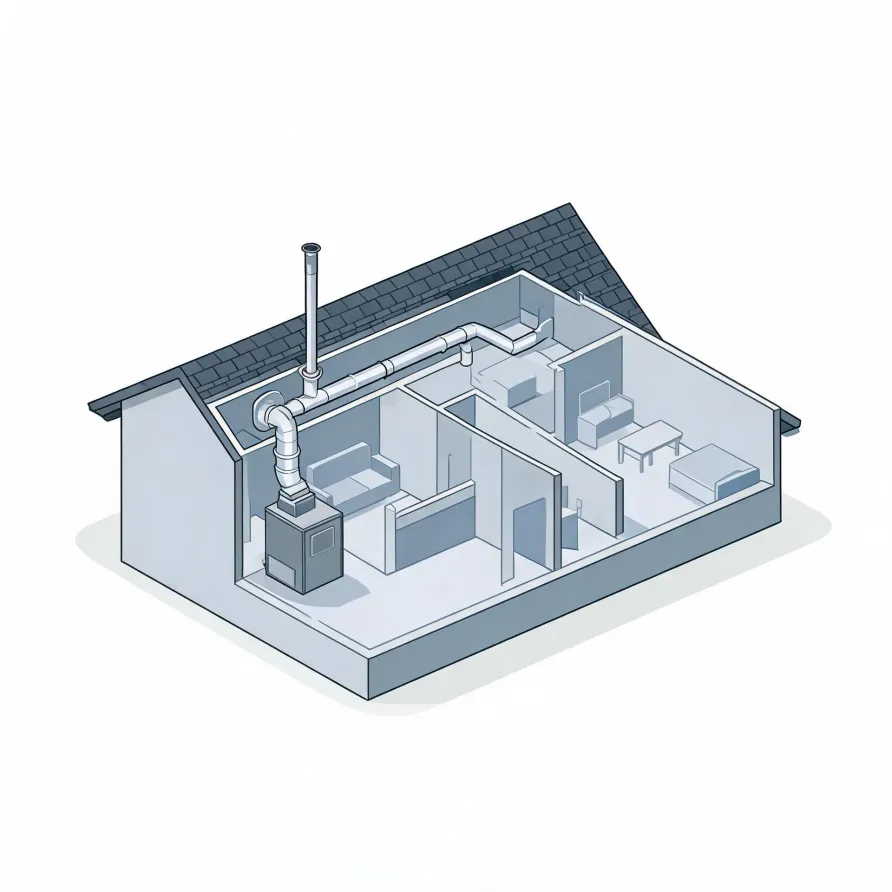
The furnace itself sits in a utility area, basement, or closet and is the core unit a contractor puts in place. Attached to it is the flue or exhaust vent, which runs through the wall or up through the roof to carry combustion gases out of the house. The heat exchanger lives inside that cabinet, transferring heat to the air before it moves on.
The blower motor sits inside the furnace cabinet and pushes conditioned air through the supply side of the system. The thermostat mounts on an interior wall and is the control point a contractor wires to the new unit. A filter housing, positioned at the air intake, holds the filter that a contractor fits during the installation.
The drawing shows a general layout of these components, and a licensed contractor determines exactly what applies to your house.
Get matched in Dearborn CountyDearborn County, Indiana, by the numbers
87 severe weather events were recorded in Dearborn County, Indiana between 2015 and 2024.
NOAA National Centers for Environmental Information, Storm Events Database, bulk CSV export, events 2015-01-01 through 2024-12-31.Half the homes in Dearborn County, Indiana were built in 1982 or earlier (2020-2024 ACS 5-year).
U.S. Census Bureau, 2020-2024 American Community Survey 5-Year EstimatesDearborn County, Indiana holds 21,098 housing units (2020-2024 ACS 5-year).
U.S. Census Bureau, 2020-2024 American Community Survey 5-Year EstimatesOwners occupy 85.2% of the occupied homes in Dearborn County, Indiana (2020-2024 ACS 5-year).
U.S. Census Bureau, 2020-2024 American Community Survey 5-Year EstimatesFurnace Installation Rules for Dearborn County, Indiana4 codes, standards, and laws
What the Installation Actually Looks Like
Non-weatherized gas furnaces manufactured on or after November 19, 2015 must reach 80.0 percent AFUE.
Non-weatherized oil-fired furnaces manufactured on or after November 19, 2015 must reach 83.0 percent AFUE.
Mobile home gas furnaces manufactured on or after November 19, 2015 must reach 80.0 percent AFUE.
Non-weatherized gas furnaces manufactured on or after December 18, 2028 must reach 95.0 percent AFUE, up from the 80.0 percent minimum that applies to units manufactured before that date.
Severe Weather Events in Dearborn County
Heating and cooling equipment in Dearborn County carries a workload shaped by local conditions, and severe weather is part of that load. A furnace that cycles through hard winters and a system that handles volatile swings between seasons both age and perform differently than equipment installed in milder climates, which is why local weather history belongs on a page about installation.
87 severe weather events, 2015–2024. Source: NOAA National Centers for Environmental Information, Storm Events Database.