Tell us about the job
Takes about a minute. No obligation.
Sizing a boiler for a Warren County home is a local engineering question, not a catalog lookup by square footage. 190 severe weather events were recorded in Warren County, Ohio between 2015 and 2024. Severe weather at that rate means the heating system cycles through conditions that push it toward its rated limits regularly, not once in a bad winter. A contractor quoting a boiler replacement here has to account for that sustained demand when selecting output capacity and matching it to the building envelope, because a unit sized for a milder load will strain to keep up and wear faster than its rated service life suggests it should.
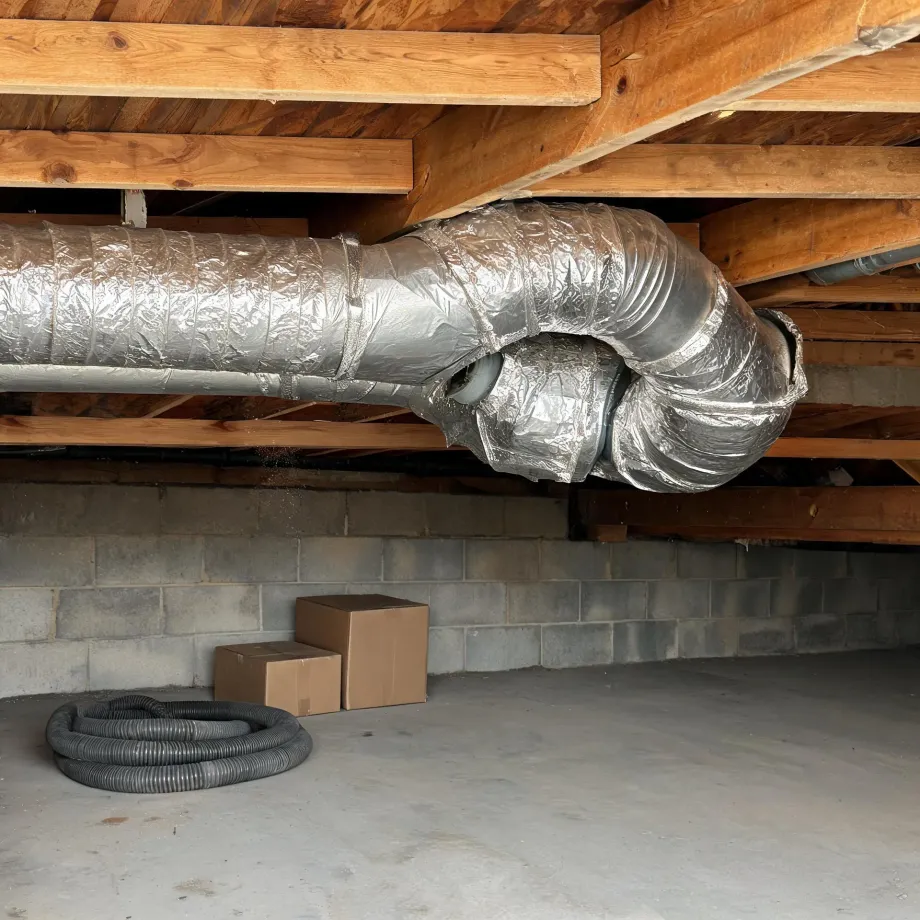
Existing ductwork is what a boiler installation in Warren County actually hinges on. Half the homes in Warren County, Ohio were built in 1995 or earlier (2020-2024 ACS 5-year). That means a contractor working through this county's housing stock is regularly opening walls and crawlspaces to read what was laid down for older equipment, checking whether the runs, dimensions, and connections will carry a modern system without being rerouted. The electrical service gets the same look. If either falls short, those findings drive the scope before any unit gets ordered.
What Gets Installed With a New Boiler
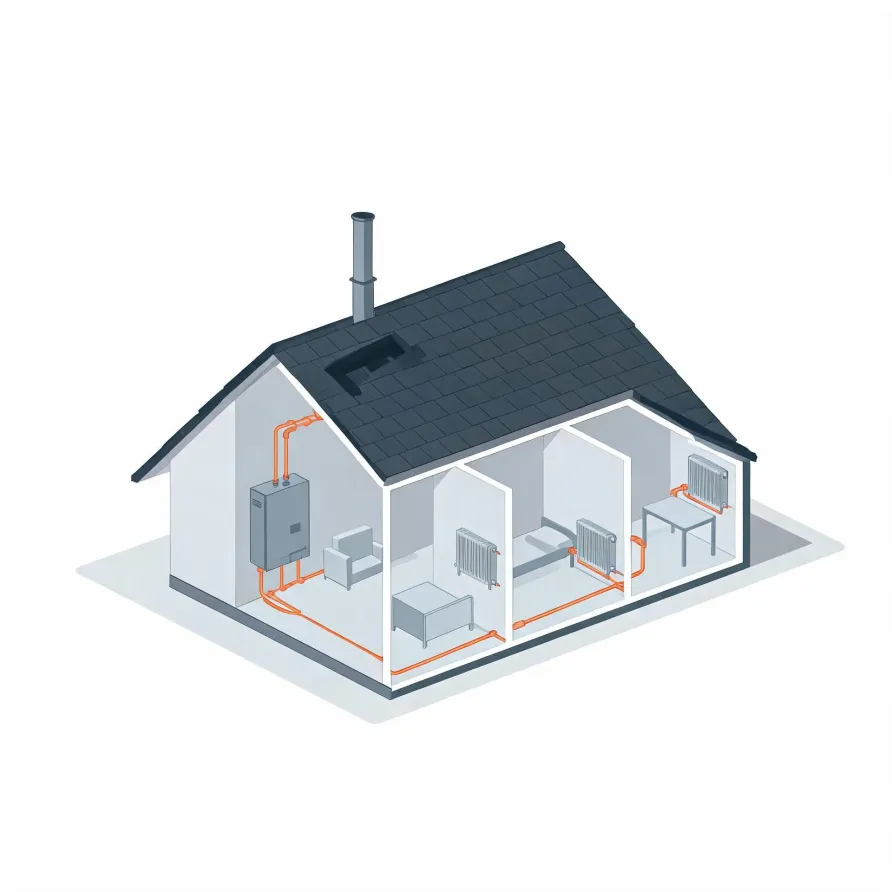
The boiler itself sits in the basement or a mechanical room and is the heart of the purchase. It heats water and pushes it out through the system. Alongside it, the expansion tank mounts nearby and absorbs pressure changes as the water heats and cools.
From the boiler, supply and return pipes run through the house to the heat emitters, which are either radiators or radiant floor loops set in each room. A circulator pump, mounted on the piping close to the boiler, keeps the heated water moving through that loop. The thermostat goes on a wall and gives the homeowner control over the whole system.
The drawing shows a typical layout, and a licensed contractor determines exactly which components and configurations apply to your house.
Get matched in Warren CountyWarren County by the Numbers
190 severe weather events were recorded in Warren County, Ohio between 2015 and 2024.
NOAA National Centers for Environmental Information, Storm Events Database, bulk CSV export, events 2015-01-01 through 2024-12-31.Half the homes in Warren County, Ohio were built in 1995 or earlier (2020-2024 ACS 5-year).
U.S. Census Bureau, 2020-2024 American Community Survey 5-Year EstimatesWarren County, Ohio holds 96,061 housing units (2020-2024 ACS 5-year).
U.S. Census Bureau, 2020-2024 American Community Survey 5-Year EstimatesOwners occupy 79.4% of the occupied homes in Warren County, Ohio (2020-2024 ACS 5-year).
U.S. Census Bureau, 2020-2024 American Community Survey 5-Year EstimatesBoiler Installation Rules on the Books for Warren County, Ohio14 sourced standards and codes
Licensing Rules for HVAC Work in Warren County, Ohio
An Ohio home construction services contract must include a copy of the supplier's certificate of insurance showing general liability coverage of not less than two hundred fifty thousand dollars.
In Ohio a home construction service means the construction of a residential building, including the repair, improvement, remodel or renovation of an existing structure, and does not include construction on a structure containing four or more dwelling units except for work on an individual dwelling unit within it.
A home construction service supplier in Ohio is defined as a person who contracts with an owner to provide home construction services for compensation and who maintains a general liability insurance policy of not less than two hundred fifty thousand dollars.
The Ohio construction industry licensing board issues state licenses to individuals as heating, ventilating and air conditioning contractors, refrigeration contractors, electrical contractors, plumbing contractors and hydronics contractors.
An Ohio board of county commissioners may accept a valid and unexpired Chapter 4740 license held by a heating, ventilating and air conditioning contractor toward its own licensing requirements for work on one-, two-, or three-family dwelling houses.
An Ohio board of county commissioners may adopt rules licensing heating, ventilating and air conditioning contractors who are not required to hold a state license under Chapter 4740.
In Ohio municipal law a specialty contractor includes heating, ventilating and air conditioning contractors, refrigeration contractors, electrical contractors, plumbing contractors and hydronics contractors.
An Ohio board of county commissioners may not register a specialty contractor who is required to hold a license under Chapter 4740 but does not hold a valid one.
An Ohio municipal corporation may not register a specialty contractor who is required to hold a license under Chapter 4740 but does not hold a valid one.
In Ohio building law a residential building means a one-family, two-family or three-family dwelling house and any accessory structure incidental to it, and does not include an industrialized unit, a manufactured home or a mobile home.
Ohio's contractor licensing chapter reaches only work on a construction project, and a construction project is defined to exclude residential buildings, so an HVAC contractor working on a one-, two-, or three-family dwelling in Ohio falls outside the state licensing requirement.
Violating Ohio's contractor licensing prohibition is a minor misdemeanor on a first violation and a misdemeanor of the fourth degree on subsequent violations.
Under Ohio law no person may act as or claim to be a type of contractor that Chapter 4740 licenses unless that person holds a license issued under that chapter.
In Ohio a home construction service supplier may not perform a home construction service costing twenty-five thousand dollars or more without entering into a written home construction services contract with the owner, unless the supplier and owner enter into a cost-plus contract.
Severe Weather Events in Warren County
Warren County's weather puts real load on heating and cooling equipment over time. A boiler sized and installed for local conditions holds up better than one spec'd for somewhere else.
190 severe weather events, 2015–2024. Source: NOAA National Centers for Environmental Information, Storm Events Database.